
E-mail templates#
sysman sysadmin
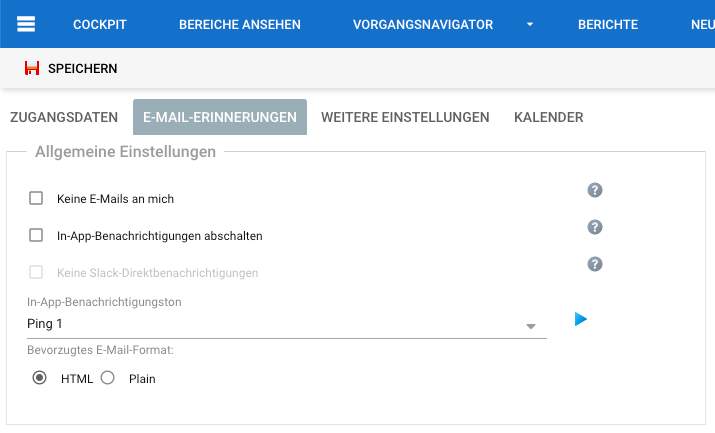
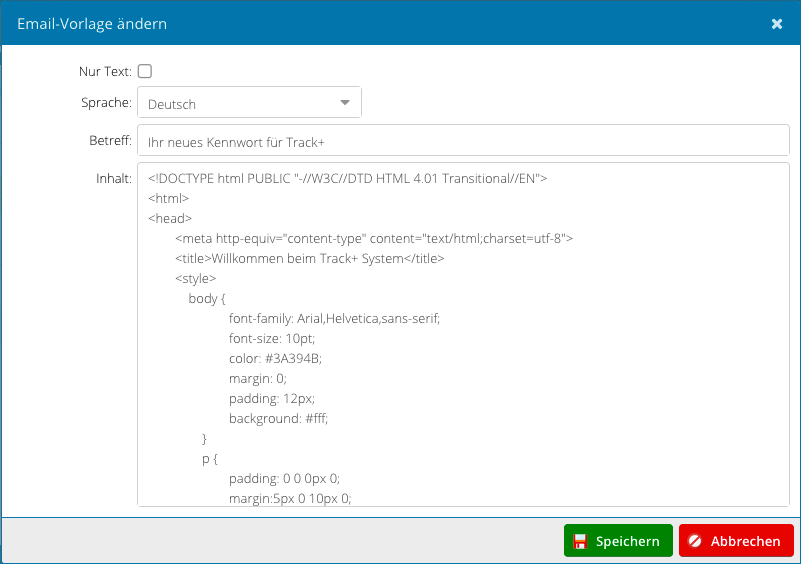
For notifications sent by e-mail there are templates that let you define the content and presentation of the messages. Each template can be defined in several languages and, for each language, both in HTML format and as a plain text message.
Go to Administration > Templates >
E-mail templates.
Template types#
Every template is based on a template type. The following table describes the template types available for item-related notifications. Templates of the template type “Item change” are also available for workflows. Editing a set of items does not trigger a notification event.
Template type |
Event |
|---|---|
Item change |
Item created or changed |
Item created by e-mail |
Item created by e-mail |
Item plan/expense |
Expenses changed |
Comment added |
Comment added |
Reminder |
Global reminder of due items |
Send from item |
E-mail sent from the item |
Item reminder |
Item-related reminder |
E-Mail item creation rejected |
Item could not be created by e-mail |
The following table describes the template types available for administration- and system-related notifications.
Template type |
Event |
|---|---|
Welcome |
Welcome message after (self-) registration |
Forgot password |
Response to the “Forgot password” action |
Calendar change |
Calendar change |
Two factor authentication |
Code for two-factor verification |
Plugin |
Templates for plugins |
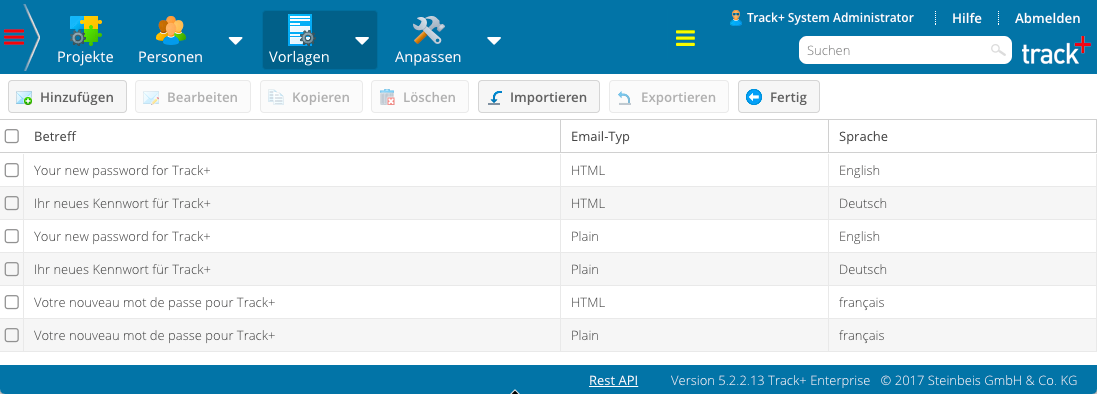
You assign templates either globally, specifically for an item type or a workspace type, or even per workspace, by dragging them from the right-hand pane to the desired position in the second column. Each template comes in two variants: HTML and plain text. Each template can be provided in a number of locales. You can import and export complete template sets or just individual templates.
Editing and assigning e-mail templates#
Changing an e-mail template#
Template macro language#
Templates are written in the Freemarker macro language (see https://freemarker.apache.org/docs/index.html). The following listing shows part of the HTML e-mail template for item changes as it is shipped with Allegra.
<#macro renderShortFields fieldChangeRows>
<#list fieldChangeRows as fieldChange>
<tr>
    <td align="right" bgcolor="#d8e1ed"
            style="width: 26%;">
            ${fieldChange.localizedFieldLabel}:
    </td>
    <#-- if copy we are not interested in the
        change compared to the original workItem -->
    <#if !fieldChange.changed>
        <#assign bgcolor=bgcolorCellNormal>
    <#else>
        <#assign bgcolor=bgcolorCellChanged>
    </#if>
    <td bgcolor="${bgcolor}" style="width: 37%;">
    ${fieldChange.newShowValue}
    </td>
    <td bgcolor="#edf0f6" style="width: 37%;">
    ${fieldChange.oldShowValue}
    </td>
    </tr>
</#list>
</#macro>
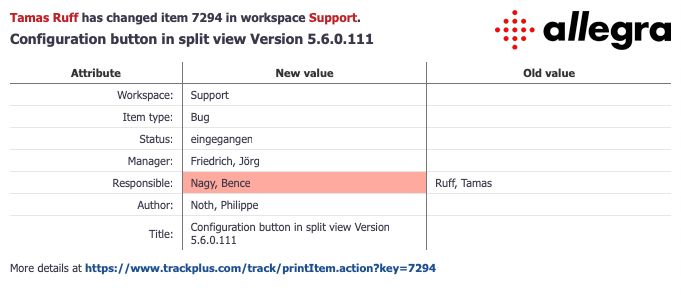
The template module provides a number of variables for the templates. Most of these variables are child variables of FieldChangeRows. They let you generate e-mails like the one shown below.
Template attributes#
The following attributes are available for e-mail templates:
Variable |
Description |
|---|---|
changedBy |
The person who caused the e-mail event |
changeDetail |
A localized text string as described in the code below |
createdBy |
The person who created this item (in the case of creation) |
isAddComment |
True if a comment was added |
isClose |
True if the item was closed |
isCreated |
True if this item has just been created |
isCopy |
True if this item has just been copied |
isDateChanged |
True if the start or end date was changed |
isDeleteComment |
True if a comment was deleted |
isEditComment |
True if a comment was edited |
isManagerChanged |
True if the manager was changed |
isMove |
True if the item was moved to a new item type or workspace |
isOtherChanged |
True for any change that was not specified more explicitly |
isReopen |
True if a closed item was reopened |
isResponsibleChanged |
True if the responsible was changed |
isStateChanged |
True if the item state was changed |
itemNo |
The item number |
longFieldChanges |
A list of item attributes for “long” attributes such as descriptions and comments |
longFieldChanges.fieldChange |
A single attribute |
longFieldChanges.fieldChange.changed |
True if this attribute was changed |
longFieldChanges.fieldChange.newShowValue |
The new or actual attribute value |
longFieldChanges.fieldChange.oldShowValue |
The old attribute value |
marker |
Default is [ Allegra <item number>] |
moreInfo |
The link to the item within the Allegra system |
oldIssue |
Only in the case of a copy: the original item number |
project |
The workspace or project for this item |
shortFieldChanges |
A list of item attributes for “short” attributes |
shortFieldChanges.fieldChange |
A single attribute |
shortFieldChanges.fieldChange.changed |
True if this attribute was changed |
shortFieldChanges.fieldChange.newShowValue |
The new or actual attribute value |
shortFieldChanges.fieldChange.oldShowValue |
The old attribute value |
subject |
Default is ${marker} [${{project}] ${changeDetail} |
submitterEmail |
The e-mail of the submitter if the item was created by e-mail or if it was entered by another user |
title |
The item title |
tokenExpression |
For authorizing unknown e-mail senders, see Email-specific access permission |
The following listing describes how the changeDetail variable is constructed.
private String getSubjectSuffix(Integer workItemKey, String synopsis,
                                String newStateLabel, Locale actualLocale) {

    String subjectPatternKey = null;
    //the last complying flag wins
    if (isAddComment) {
        subjectPatternKey = "item.mail.subject.addComment";
    }
    if (isEditComment) {
        subjectPatternKey = "item.mail.subject.editComment";
    }
    if (isDeleteComment) {
        subjectPatternKey = "item.mail.subject.deleteComment";
    }
    if (isOtherChanged) {
        subjectPatternKey = "item.mail.subject.trail";
    }
    if (isManagerChanged) {
        subjectPatternKey = "item.mail.subject.managerChanged";
    }
    if (isResponsibleChanged) {
        subjectPatternKey = "item.mail.subject.responsibleChanged";
    }
    if (isDateChanged) {
        subjectPatternKey = "item.mail.subject.dateChange";
    }
    if (isMove) {
        subjectPatternKey = "item.mail.subject.move";
    }
    if (isStateChanged) {
        subjectPatternKey = "item.mail.subject.stateChange";
    }
    if (isClose) {
        subjectPatternKey = "item.mail.subject.closed";
    }
    if (isReopen) {
        subjectPatternKey = "item.mail.subject.reopen";
    }
    if (isCreated || isCopy) {
        subjectPatternKey = "item.mail.subject.new";
    }
    String changeDetail = "";
    Object[] subjectArguments = {workItemKey, //for new
            synopsis,
            newStateLabel, //for state change
            //newProjectLabel,
    };
    changeDetail = LocalizeUtil.
                getParametrizedString(subjectPatternKey,
            subjectArguments, actualLocale);
    return changeDetail;
}